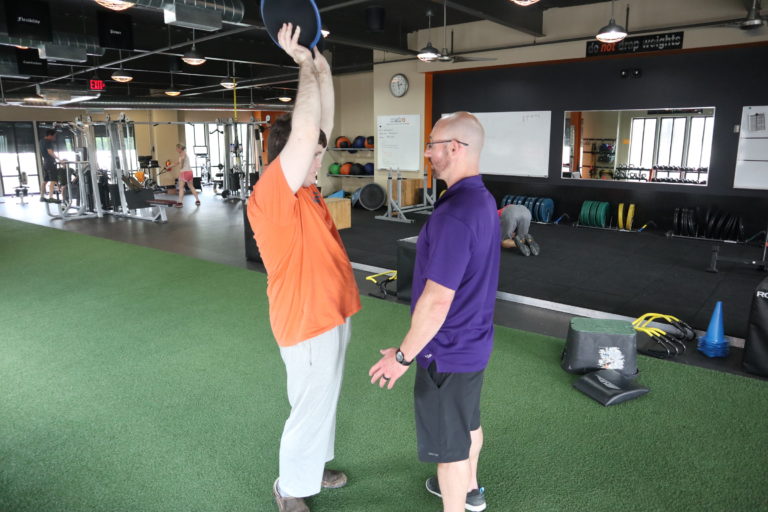
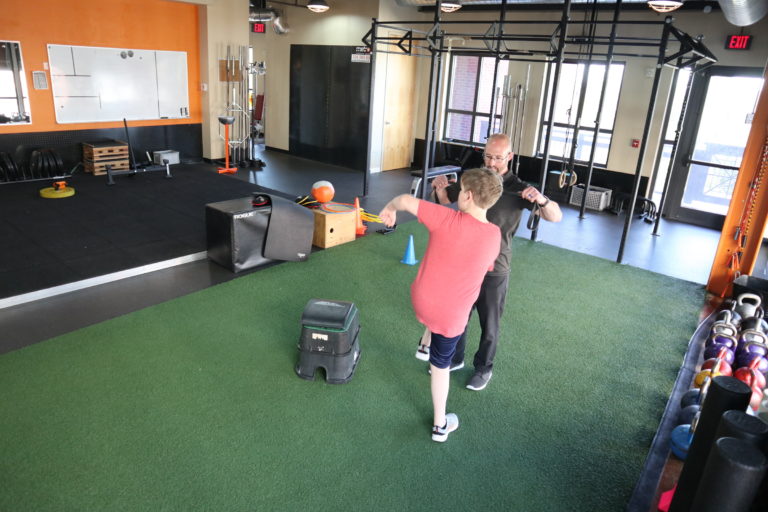
The bending/squatting motion is possibly one of the most important big movements that we do throughout the day, in daily life activities, sports, and play (I did not mean for that to rhyme). The majority of young people on the autism spectrum with whom I work have a tendency to pitch forward (see below) when they attempt a squat.

Problematic squat

Problematic squat

Does the individual with autism that you work/live with squat this way or something similar to this? The research done on many young individuals with autism suggests that there is a higher rate of gross motor deficits in the ASD population than typically-developing individuals.  The reason appears to be cyclical; Those with autism are predisposed to greater motor deficits, and sedentary lifestyles combined with poorly-implemented “adaptive” PE programs do not engage young people in these activities.

Before passing on the importance of squatting as “only something weightlifters” or “fitness people do” take a look at the picture below

Not quite the assumed muscle-head, eh?

Not quite the assumed muscle-head, eh?

We EVOLVED to squat. It is not just a skill for sports.  If we do not begin to or learn to perform it properly, we risk a laundry list of problems from lower back pain to gait pattern issues to knee injuries.  I am a big proponent of a non-verbal adolescent on the autism spectrum NOT having low back pain.

Will developing strength and good posture in different bending/squatting situations make kids better at sports? Sure! But most of us living with and/or working with the young autism community don’t care much about sports, or shouldn’t in the majority of cases. We should however, make it a point to develop healthy, optimally functioning sons, daughters, students, and clients.  Through developing physical skills, we open up a world of new possibilities. That’s not a nice way of wrapping up this post, but both a truth and a challenge to those reading along.

Some great bending/squatting activities:

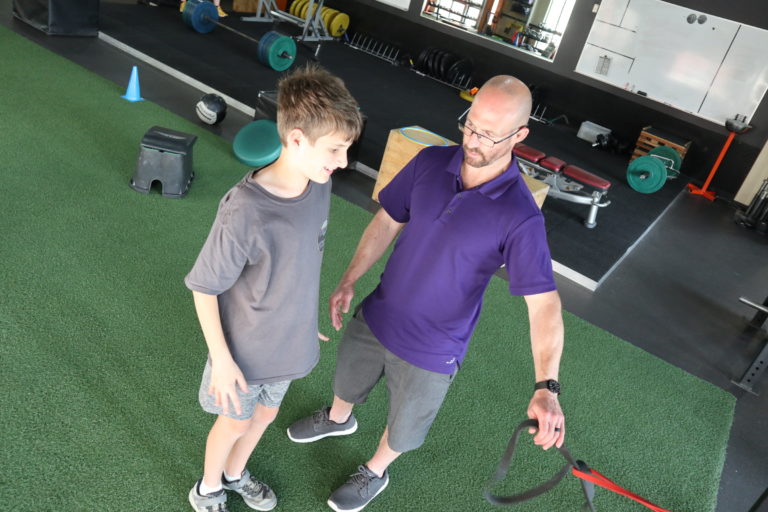
- Squat while holding an anchored band

- Bear walks

- Frog hops

- Backwards frog walk

Live Inspired,

-EC

www.AUTISMFITNESS.com

Share and Enjoy:
  • E-mail this story to a friend!
  • StumbleUpon
  • Digg
  • TwitThis
  • Facebook
  • Reddit
  • Mixx
  • Technorati
  • del.icio.us
  • Sphinn
  • Google
  • Bumpzee
  • De.lirio.us
  • Ping.fm
  • Pownce
  • Print this article!

Filed under Blog by

I’m less of a written-in-stone type of person than I am a carry a heavy stone for 30 yards type of professional. There are, however, certain concepts that I apply to every aspect of my fitness programs for the young autism population:

THE FIVE RULES OF AUTISM FITNESS:

1) You Can’t Force Fun

Tell a a kid mid-meltdown that she’s having a good time. Suggest to the reluctant teen with high-functioning autism that “It’ll be a blast!” if he learns to squat correctly. We have to motivate through both demonstration and by identifying what else is reinforcing for the individual. It certainly isn’t fitness…yet.

2) Use the Big Five Movement Patterns

- Pushing (movement away from the body)

- Pulling (movement towards the body)

- Rotation (movement around the body)

- Bending (lower body pushing or pulling)

- Locomotion (Getting from point A to point B)

Use them in circuit stations, or one after another, use them in combination, create your own. Pretend the movements are Leggos. What can you build?

3) If we move regularly and vigorously, we are ATHLETES

I’m not redefining the term for semantic reasons, but for practical reasons. How many of us play team sports into adulthood? Are sports the only thing we can do to be active and healthy? Lightbulb. We need to expand the definition to include much more in the way of movement.

4) Sports do NOT equal Fitness

Sports are SPECIFIC, Fitness is GENERAL. We need to be FIT to participate in sports (to be safe from injury and to excel), we do not need to play sports to be physically healthy, able, and capable.

5) Structured teaching for Chaotic Use (The Principle of PLAY)

We need (all of us) to play more. Skip, run, crawl, hop, jump, throw, laugh, repeat. If the foundational skills are not yet developed, and if movement is not motivating, it will be difficult to engage in free play.

I am diligently finishing up the PAC Profile Assessment program. I want it ready by the end of the month so that educators can begin incorporating fitness into the classroom as an addition to or replacement for ( in the event that one does not exist in the school) adaptive PE programs. Look for more info soon on www.AUTISMFITNESS.com

Summer Exercise and Bike Riding Clinic with NY Metro NAA

Summer Exercise and Bike Riding Clinic with NY Metro NAA

Live Inspired,

-EC

www.AUTISMFITNESS.com

www.ERICCHESSEN.com

Share and Enjoy:
  • E-mail this story to a friend!
  • StumbleUpon
  • Digg
  • TwitThis
  • Facebook
  • Reddit
  • Mixx
  • Technorati
  • del.icio.us
  • Sphinn
  • Google
  • Bumpzee
  • De.lirio.us
  • Ping.fm
  • Pownce
  • Print this article!

Filed under Blog by

In just a few weeks I will be releasing the Autism Fitness PAC Profile Assessment Program. This program reflects nearly ten years of developing fitness programs for the young autism population. The PAC profile enables parents, educators, fitness professionals, and therapists to develop fitness programs for individuals and groups with ASD regardless of their current abilities. The program can be implemented in the classroom, home, or any suitable environment. More info to come.

Live Inspired,

-EC

Share and Enjoy:
  • E-mail this story to a friend!
  • StumbleUpon
  • Digg
  • TwitThis
  • Facebook
  • Reddit
  • Mixx
  • Technorati
  • del.icio.us
  • Sphinn
  • Google
  • Bumpzee
  • De.lirio.us
  • Ping.fm
  • Pownce
  • Print this article!

Filed under Blog by

There are some common themes I notice within ineffective fitness/movement/just about any program for the young autism population. Here are the top five:

1) Not beginning at the baseline

Teaching any skill, from throwing a ball to brushing teeth requires an understanding of what the individual can already do. Teaching skills that are too advanced (most sports skills) or specific is a sure way to frustrate both instructor and learner.

2) Not pairing movement activities with other reinforcement

Most of my athletes with autism did not start out enjoying exercise. It takes patience, persistence, and figuring out the right activities. Most of us dislike doing things we are not good at. By pairing or associating exercise activities with something that is ALREADY MOTIVATING, young people with ASD begin to enjoy fitness much more.

3) The “Don’t, No, Can’t” Model of Coaching

For ABA-trained therapists, the “DNC” model of teaching sends chills up and down and back up the spine. When we focus on what a learner is doing INcorrectly rather than what they are doing well, it often results in more errors. There are 1,000 different ways to perform an activity sub-optimally. We want our athletes with autism to come into contact with what they do well, even if it is just standing in one spot.

4) Teaching with Objects rather than Objectives

I like cool stuff, you like cool stuff, we all like cool stuff. When we work with a piece of equipment (weight machines, sport-specific models) and ONLY that piece of equipment, individual goals and needs often go forgotten. If we teach from a CONCEPTUAL framework (the Big 5 movement patterns, teaching skills sets at the pace of the learner) it allows us to create more individualized, successful programs.

5) You Can’t Force Fun

Telling someone they “have to” do something is not a wonderful way to increase their enjoyment of the activity. Having open-ended fitness sessions where we can jump, throw, lift, and play any way we want allows for both naturalistic teaching and a sense of mastery over new activities. Teaching can be structured, but allow for deviation. It may be play in disguise.

Live Inspired,

-EC

www.AUTISMFITNESS.com


Share and Enjoy:
  • E-mail this story to a friend!
  • StumbleUpon
  • Digg
  • TwitThis
  • Facebook
  • Reddit
  • Mixx
  • Technorati
  • del.icio.us
  • Sphinn
  • Google
  • Bumpzee
  • De.lirio.us
  • Ping.fm
  • Pownce
  • Print this article!

Filed under Blog by

Here is my full presentation from this past weekend’s Autism Society of America Conference in Dallas.

Share and Enjoy:
  • E-mail this story to a friend!
  • StumbleUpon
  • Digg
  • TwitThis
  • Facebook
  • Reddit
  • Mixx
  • Technorati
  • del.icio.us
  • Sphinn
  • Google
  • Bumpzee
  • De.lirio.us
  • Ping.fm
  • Pownce
  • Print this article!

Filed under Blog by