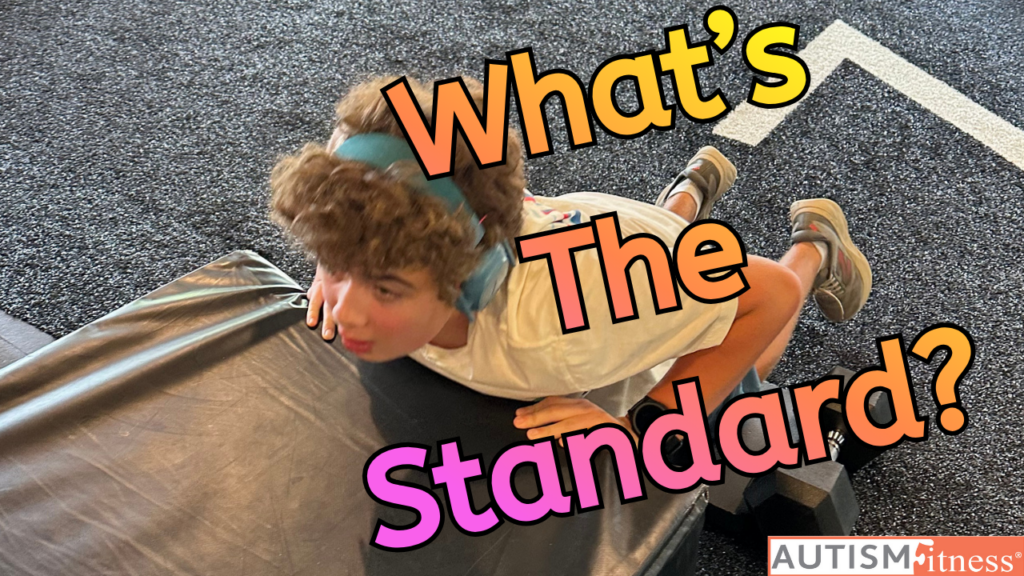
Strength is a skill; and a highly overlooked one for the autism and neurodivergent populations.
Take eighteen seconds to sit with that sentence.
Now think about it in relation to any other skill you’ve ever taught. Does it just innately manifest? Or is there teaching, repetition, and improvement involved?
One of the most misunderstood aspects of strength training — of exercise in general — is that movement is skill-based. It has to be taught, practiced, and refined like anything else.
For our autism and neurodivergent populations, this matters even more. Motor control challenges are common, and they can inhibit or delay an athlete’s capability with resistance exercises. The result: building meaningful strength takes longer and requires a more dedicated, dialed-in approach than a generic program can offer.
So Where Do We Start?
If strength is a skill, we need a way to assess current ability and determine the right level of challenge — or support — for each exercise. That starting point is standards.
A standard for each exercise gives us the ability to assess and compare an athlete’s current capability against how that exercise needs to be performed for safety and effectiveness. Meeting the standard means:
- The exercise is being performed safely
- Healthy range of motion and tempo are used
- Sufficient volume (sets and reps) is achieved to induce a training effect
- The athlete is independent with the exercise, aside from the occasional coaching cue
The Easy Mistake to Make
With common adaptive, behavioral, and cognitive challenges in the mix, it’s easy to overlook technique or settle for a modification that isn’t quite right — either too easy to drive progress or too hard to be sustainable. Finding that “Goldilocks zone” takes intention.
Skipping that step is a mistake. It deprives the athlete of the opportunity to improve performance in all the ways that actually matter — strength, independence, confidence, and carryover to daily life.
The Takeaway
Strength doesn’t just happen. It’s built, one well-taught rep at a time. Having clear standards for each foundational exercise is what lets us know where an athlete is starting from — and exactly how to progress them from there.
Having “standards” is not exclusionary, rather they give us valid, objective targets for assessing and comparing baseline performance, In short; the science of goal-setting in strength training. Given the challenges in motor skills, motivation, and motor imitation often experienced/exhibit, it is necessary to assess all three areas of skill as they relate to movement; physical, adaptive, and cognitive. Only by doing this can we make sound decisions for strength programming that makes sense (level of challenge, level and type of support, volume, and coaching communication).
To learn more about the different ways we define and program based on standard performance of strength exercises for our autism and neurodivergent life skill athletes, watch the video below