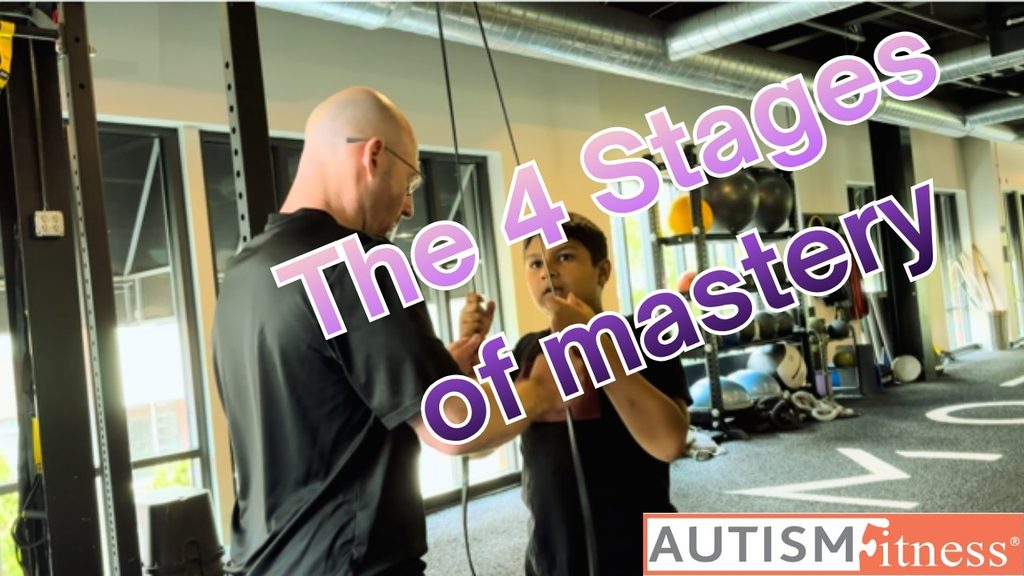
It’s one of the questions coaches and trainers hear most from parents and caregivers. The short answer: progress in strength training for autistic and neurodivergent athletes isn’t measured in weeks or months. It’s measured in phases.
Every athlete moves through four phases of exercise mastery for each exercise: Introduction, Accumulation, Intensification, and Mastery. Some athletes move from one phase to the next in a single session. Others take weeks or months. Knowing which phase an athlete is in tells you far more than a calendar ever will.
What are the four phases of exercise mastery?
Phase 1: Introduction
The learning phase. The athlete is seeing and practicing the exercise for the first time.
Phase 2: Accumulation
More sets and reps, with modifications and supports that build motor skills, strength, and stability.
Phase 3: Intensification
Prompts fade while weight, resistance, or range of motion increases to match independent performance.
Phase 4: Mastery
The athlete performs the exercise consistently and safely, with enough resistance to build measurable strength, and the skill carries over to activities of daily living.
Why does the phase matter?
Once you know an athlete’s phase for a given exercise, you know: Which exercises to prioritize right now How many modifications, prompts, and cues they need The right volume (sets and reps) for where they actually are When to progress to a bigger challenge
Without this framework, it’s easy to push an athlete before they’re ready or hold them back too long. Both stall progress and motivation.
How is this different from typical strength training?
The idea mirrors linear periodization, the established principle of gradually increasing training demand as strength and stamina improve. Strength coaches plan around it every day.
What’s rarely done is applying that structure intentionally to autistic and neurodivergent athletes, layered with adaptive, behavioral, and cognitive factors like communication, motor control, and information processing. That’s the gap this framework fills.
The key shift: assess each exercise individually. An athlete can be in Mastery on a goblet squat and still in Introduction on a push up.
So instead of asking “How many weeks until…?” ask “What phase are they in, and what does that tell us?”
This week’s Tuesday Training breaks down the four phases of exercise mastery: how to recognize each one and how to coach toward independent mastery.
If you coach neurodivergent athletes and have struggled to answer “how long will this take,” this framework will change how you talk about progress.