Autism Fitness: Where to Start
If you are a parent, therapist, or fitness professional wondering how to introduce strength and fitness training to an autistic or neurodivergent individual, the short answer is: start by identifying an appropriate exercise variation, the support the athlete needs to participate, and a clear way to communicate — rather than assuming inability or disinterest. The concept that makes this possible is called scalability.
What Makes Getting Started Difficult?
Often, knowing how to start can be the barrier. Because so many of our autism and neurodivergent population experience motor skill and motivational complications, introducing effective fitness programming can be overwhelming — for everyone involved.
So we need clarity, and that comes with understanding scalability in programming. In addition to understanding the concepts, knowing which exercises are going to effectively increase strength and motor skills is essential. Add to this the understanding and practice of positive behavior support and empowering communication, and it is easy to realize there is a lot that needs to happen for success.
Enter the practice of scalability.
What Is Scalability?
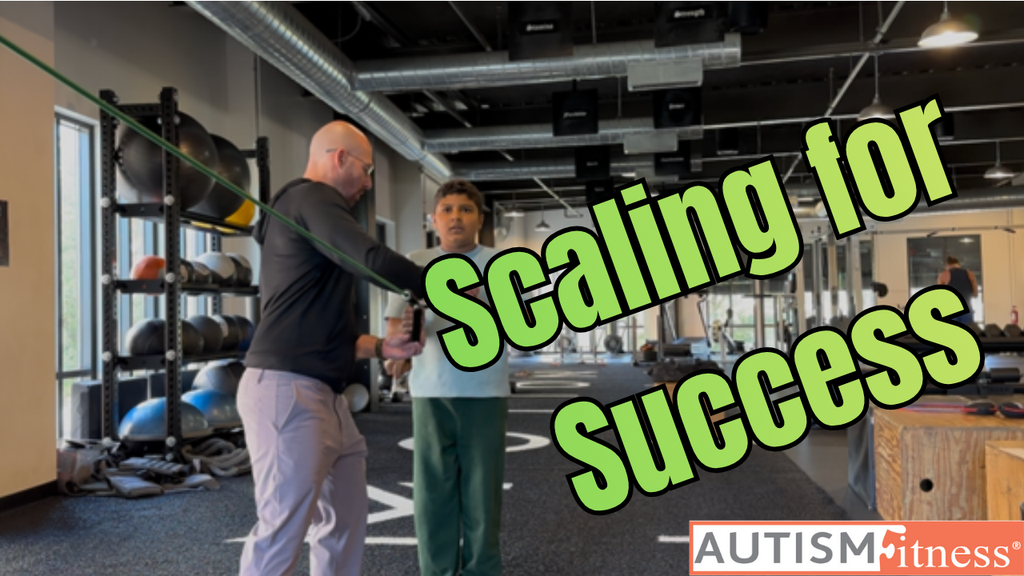
Scalability means adjusting exercises, adaptive/behavioral support, and communication to match the athlete’s current abilities and support needs while preserving the training goal. The approach can be defined as “same-but-different” — or, more precisely, highly intentional.
We don’t decide the athlete “can’t do squats” and instead have them bounce a ball. We don’t immediately conclude “they don’t understand” and spend minutes explaining why the exercise is important. We don’t immediately assume “they hate to exercise” so we just have them walk on a treadmill for 5 minutes.
These assumptions are often made when scalability is not considered, and it ultimately robs the individual of dignity, respect, and the life-changing benefits of strength training done correctly.
How Can Exercises Be Modified?
The goal is not to replace a valuable movement pattern with something arbitrary. Instead, ask: what modification does this athlete need to squat as best as possible right now? That might mean a squat to a target — an individually appropriate box or bench — that gives the athlete a clear visual endpoint and a manageable range of motion. The training goal (a strong, functional squat pattern) stays the same. Only the route to it changes.
Of course, knowing how to modify foundational exercises is an area of education and training necessary to fulfill this goal. And while it isn’t an absolute requirement to have a degree in exercise science or fitness coaching, knowing the purpose, performance, and function of foundational exercises is highly important.
How Can Coaching Be Clearer?
Rather than spending minutes explaining why the exercise is important, coaching can be more effective with a concise cue, a demonstration, and enough time for the athlete to respond. Some athletes benefit from a short verbal direction; others respond better to seeing the movement performed first. The point is to match the communication to the athlete, not to repeat the same explanation louder or longer.
In Autism Fitness coaching, we use the Label -> Demo (Demonstrate) -> Do & Cue model for eliminating excess language (AKA overcoaching) and increasing not only the athlete’s ability to start the exercise but to increase skill acquisition. This can bypass much of the frustration and anxiety experienced by not only autistic individuals, but coaches/professionals as well.
What Helps Athletes Stay Engaged?
Before concluding that an athlete “hates exercise,” it is worth asking what strategies could increase focus, engagement, and motivation. Options include adjusting the demand so success is achievable, providing a predictable structure so the athlete knows what comes next, and offering meaningful choices within the session. Engagement is often a programming variable, not a fixed personality trait.
The Three Questions to Ask
When scalability is factored in, the questions we can ask (and answer) become:
- What modification does this athlete need to squat as best as possible right now?
- How can I introduce and coach this exercise for this athlete without inviting confusion?
- What strategies can I use to increase focus, engagement, and motivation?
Scalability is one of those “of course we want to” terms — and putting it into practice in strength and fitness programming comes down to asking, and answering, these questions for every athlete. Rather than take a “just any exercise will do” approach (it won’t), we want to ask what we’re scaling, why we’re scaling it, and what a successful outcome looks like. For example, if we modify a squat by using a box for better proprioception, does it actually improve the quality of the movement?
Why Does Fitness Matter?
Strength and fitness are not just about physical outcomes — they are foundational to all areas of health. Physically, regular exercise can support motor skills, coordination, and overall fitness for autistic children and adolescents, and research links structured programs to meaningful gains in these areas (review of exercise benefits). Mentally and emotionally, physical activity has been associated with reduced anxiety and improvements in social skills, emotional regulation, and wellbeing (Sports Psychiatry narrative review), and regular activity is tied to better quality of life across physical, cognitive, and psychological dimensions (PMC quality of life study). For all of us — neurotypical and neurodivergent alike — fitness is a life skill that supports the whole person.
Get Certified
Strength and fitness deserve attention as part of physical, mental, and emotional health — not just performance in the gym. Research in autistic children and adolescents suggests benefits for physical fitness and aspects of psychological wellbeing, although findings differ by outcome and program (review of exercise benefits; integrative review of exercise interventions). To learn how to individualize exercise selection, coaching, and positive behavior support, explore the Autism Fitness Certification and take the next step toward building effective, scalable programs.
LEARN HOW TO GET AUTISM FITNESS CERTIFIED